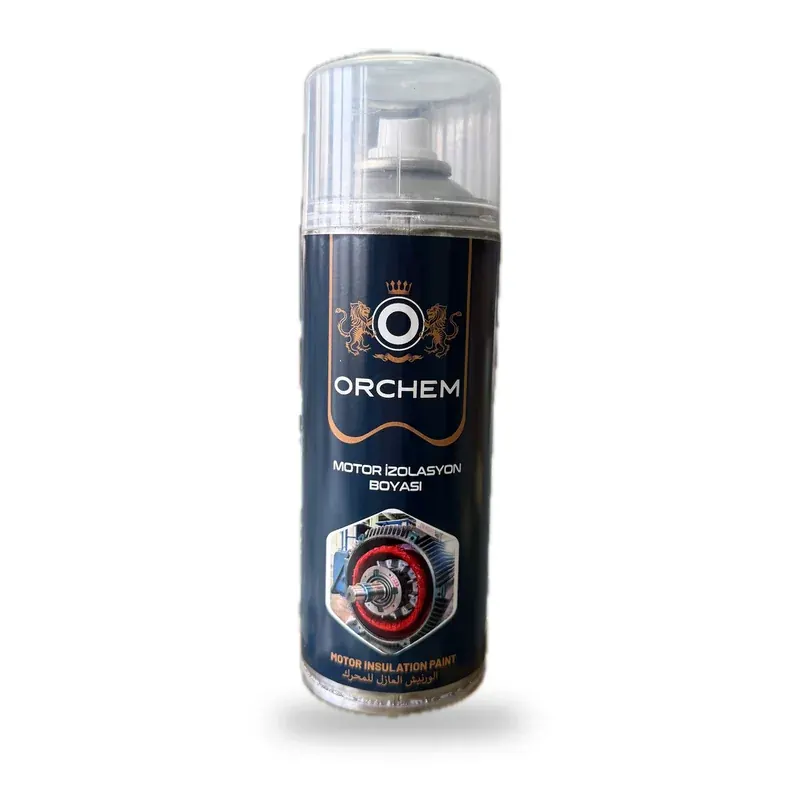


Motor Insulating Spray (Class F, Air-Drying)
Class F (155 °C) air-drying spray; coats windings, connections and terminals in one step.
Technical information
| Thermal class | F (155 °C) |
|---|---|
| Drying | Air-drying; no oven needed |
| Drying time | See product TDS |
| Application | Spray, in one step |
| Use on | Windings, connections and terminals |
| Resistance | Dust, moisture, mineral oils, weak acids/alkalis |
| Voltage | Low and medium voltage |
| Colour | Any RAL shade on request |
| Best for | Repairs, touch-ups and field work |
Drying time, viscosity and pack sizes are given in the product TDS.
Motor insulating spray is a class F (155 °C) air-drying insulating paint that coats and insulates the motor winding, connections and terminals in a single step after rewinding. It is sprayed straight from the can, needs no oven and dries at ambient temperature. It is a practical solution for repairs, touch-ups and field work.
The spray forms a protective insulating film on the surface, shielding the winding from dust, moisture, mineral oils and weak acids and alkalis. As it can be made in any RAL shade on request, it also gives a finish that matches the colour of the motor or coil.
Where is it used?
- Winding overhangs, connections and terminals of rewound electric motors,
- Connection points and outer surfaces of transformers and coils,
- On-the-spot repair of scratched, worn or locally exposed insulation,
- Local application on parts that do not fit in a dip tank or oven,
- Insulation touch-ups on low and medium voltage equipment.
Properties
- Thermal class F (155 °C): in the IEC 60085 classification, F stands for 155 °C; suitable for class F and lower-class windings.
- Air-drying: no oven needed; drying time is given in the product TDS.
- One-step protection: coats and insulates windings, connections and terminals in the same application.
- Resistance: protects against dust, moisture, mineral oils and weak acids/alkalis.
- Voltage range: for low and medium voltage insulation.
- Colour: made in any RAL shade on request.
How is it applied?
- Disconnect the equipment; never spray energized parts.
- Clean dust, oil and dirt from the surface. Dry a damp winding first; see the winding drying guide.
- Shake the can thoroughly.
- Hold the can upright and spray from a suitable distance in thin, even coats; avoid heavy coats that run.
- If needed, apply a second thin coat once the first has dried.
- Leave the part to dry in a dust-free, well-ventilated place; do not run the equipment before it is fully dry.
For the differences between dipping, brushing and spraying, see the guide how to apply motor varnish.
How to choose and what to watch for
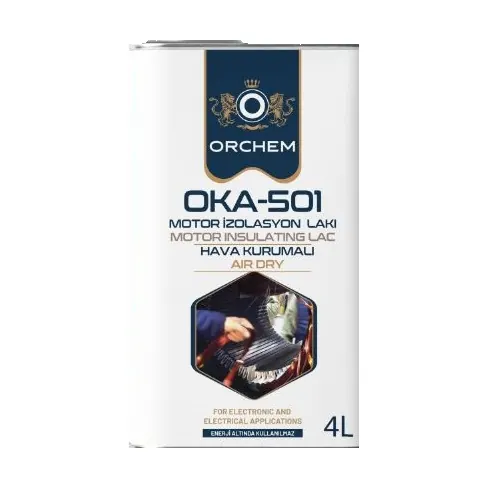
The spray is suited to coating surfaces and local repair; it does not penetrate the inner layers of a winding as deeply as varnish applied by dipping or brushing. So on a newly rewound motor, first treat the whole winding with an air-drying winding varnish or the very fast-drying OKA-501 motor insulating lacquer, and use the spray as a complement for connections, terminals and touch-ups.
If you need a thicker, more durable topcoat, see insulating topcoat lacquers and paints; the guide is an insulating topcoat necessary? explains when one is needed. Other spray products are on the spray products page.
Common mistakes
- Spraying a damp or oily surface: the film does not bond and insulation resistance comes out low.
- One heavy coat: it runs and dries slowly.
- Using the spray instead of impregnating varnish: the inside of the winding can be left unprotected.
- Not shaking the can: colour and film come out uneven.
- Running the equipment before it is fully dry.
Safety and storage
The spray can is pressurized and contains solvents. Use it in a well-ventilated place away from open flames and sparks; do not pierce or burn the can or leave it in the sun. Store in a cool, dry place. Detailed safety information is given in the safety data sheet.
For the technical data sheet (TDS) and colour options of the motor insulating spray, write to us via the form or WhatsApp.
Questions
What is motor insulating spray used for?
Motor insulating spray coats and insulates windings, connections and terminals in one step after rewinding. It protects the surface against dust, moisture, mineral oils and weak acids/alkalis.
How long does motor insulating spray take to dry?
It air-dries without an oven; touch-dry and full-dry times are given in the product TDS, which you can request via the form or WhatsApp. Cold, humid conditions lengthen drying.
Can the spray replace winding varnish?
Not entirely. The spray coats surfaces and suits local repair; to penetrate a newly rewound winding, winding varnish should first be applied by dipping or brushing.
What thermal class is the motor insulating spray?
It is class F (155 °C) and can be used on class F and lower-class windings.
Is the motor insulating spray available in different colours?
Yes. It can be made in any RAL shade on request; write to us via the form or WhatsApp for colours.
Can motor insulating spray be used at high voltage?
No. Motor insulating spray is intended for low and medium voltage insulation.
Can I spray a running motor?
No. Disconnect the equipment, clean and dry the surface, then apply.