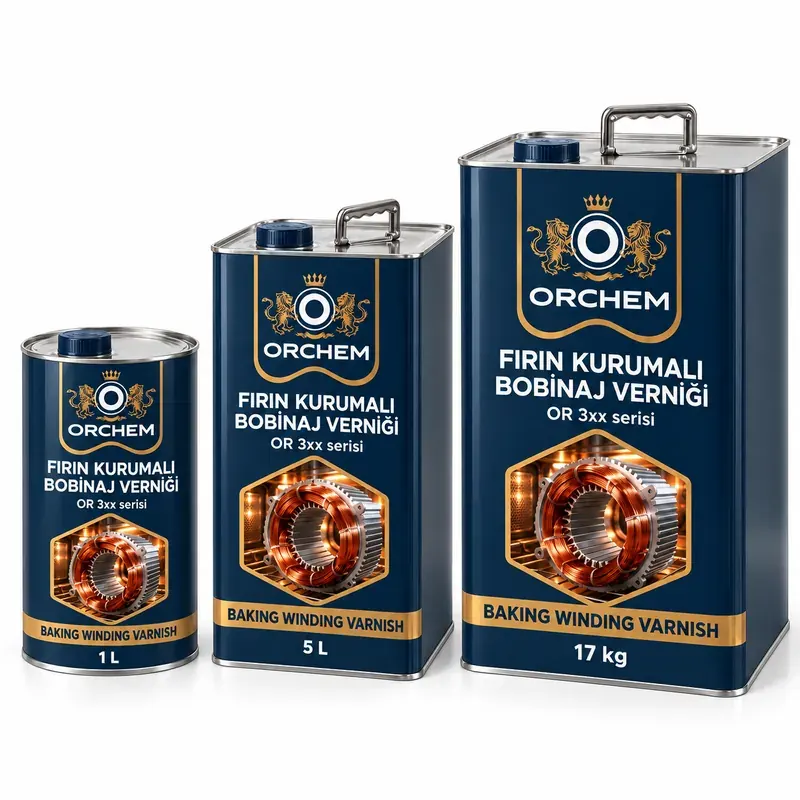


Baking Winding Varnish (OR-300, Class H)
OR 3xx series. OR-300: class H (180 °C), for dipping and VPI; the highest bond strength.
Technical information
| Series | OR 3xx |
|---|---|
| OR-300 | One-component, solvent-based, oven-cured electrical insulating varnish |
| Thermal class | H (180 °C), IEC 60085 |
| Viscosity | 60 s, DIN Cup 4 (20 °C) |
| Solids | 50 % (by weight) |
| Appearance | Clear (yellow) |
| Density | 0.99 g/cm³ (20 °C, DIN 51757) |
| Flash point | 32 °C (flammable) |
| Thinner | T-300, 2–8 % of volume |
| Application | Dipping or VPI (vacuum pressure impregnation) |
| Preheating | 30 min at 80 °C |
| Oven cycle | 4 h at 200 °C, 6 h at 140 °C or 7 h at 130 °C |
| Chemical resistance | Resists pure water, 10 % sulphuric acid, 1 % sodium hydroxide and oils; not corrosive to copper |
| Compliance | RoHS |
| Use | Electric and traction motors, LV/MV transformers, shunt reactors, chokes, VPI lines |
| Packaging | 16 kg tin, 200 kg drum |
| Shelf life | 1 year (20 °C, in closed original packaging) |
Drying time, viscosity and pack sizes are given in the product TDS.
Baking varnishes
| Product | Base | Thermal class | Properties and use |
|---|---|---|---|
| OR-300 | One-component, solvent-based | H · 180 °C | Oven-cured motor and transformer insulating varnish; applied by dipping or VPI |
| OR-305 | See TDS | H · 180 °C | Baking transformer insulating varnish; applied by dipping, VPI or spray gun |
| OR-306 | Water-based | See TDS | Water-based baking insulating varnish |
| OR-307 | See TDS | See TDS | LF: low-VOC baking insulating varnish |
| OR-3200 | See TDS | See TDS | Varnish for glass-fibre insulated wire production |
| OR-4200 | See TDS | See TDS | Can/coil: varnish and paint for tinplate and sheet coating |
Download the detailed TDS (PDF)
Summary values are in the table above. For the detailed TDS with all test methods, application and storage information, leave your name and email; the PDF downloads right away.
Baking winding varnish is an electrical insulating varnish that hardens by curing in an oven at a set temperature and time after the winding has been impregnated. Orhun Kimya's core product in this group is OR-300: a one-component, solvent-based, class H (180 °C, IEC 60085) varnish applied by dipping or VPI (vacuum pressure impregnation) and adjusted with T-300 thinner.
Fully oven-cured varnish turns the winding wires into a single solid block. That is why, in series production and in motors and transformers running under vibration and heavy load, it gives higher bond strength and heat resistance than air-drying varnishes.
Where is it used?
- Electric motors and traction motors,
- Low- and medium-voltage transformers,
- Shunt reactors and choke coils,
- Series production with VPI lines and dip tanks,
- Windings that will run in humid conditions, in submersible pumps or in hot oil.
Properties of OR-300
- Class H thermal endurance: 180 °C (IEC 60085).
- Solids and consistency: 50 % solids by weight; viscosity 60 s (DIN Cup 4, 20 °C).
- Chemical resistance: resistant to pure water, 10 % sulphuric acid, 1 % sodium hydroxide and oils; non-corrosive to copper.
- Appearance: clear, yellow film.
- RoHS compliant.
- Packaging and shelf life: 16 kg can and 200 kg drum; 1 year at 20 °C in the closed original packaging.
Other products in the series
Alongside OR-300, the baking varnish table includes: the class H OR-305 for transformers, applied by dipping, VPI or spray gun (baking transformer varnish), the water-based OR-306, the low-VOC OR-307 (LF), OR-3200 for glass-fibre insulated wire production and OR-4200 for can and coil coating. Their values are in their own TDS.
How is it applied?
- Clean the winding and preheat it at 80 °C for 30 minutes to drive out moisture. See the winding drying guide.
- Keep the tank viscosity at 60 s (DIN Cup 4, 20 °C) with T-300 thinner; the thinner is added at 2–8 % of the volume.
- Dip the part or impregnate it by VPI; wait until bubbles stop rising. For the method, see what is VPI.
- Let the excess varnish drain off.
- Put it in the oven: 4 hours at 200 °C, 6 hours at 140 °C or 7 hours at 130 °C. Start timing once the part has reached oven temperature.
- Do not take it out early; let the motor cool completely before running it.
How to choose and what to watch
If you have an oven and the work is planned, a baking varnish gives the strongest result. Without an oven, or if the motor does not fit, use the air-drying OR 1xx; a baking varnish does not fully cure in air. If you need class H but have no oven, look at the two-component OR-114. The class B, F and H guide explains thermal classes.
The flash point of OR-300 is 32 °C; the varnish is flammable. Ventilate the dip tank and oven area well and keep away from open flames.
Common mistakes
- Leaving it to air-dry: The surface may look dry, but the inside does not cure and stays tacky. Details in why varnish does not dry.
- Starting the clock too early: Heavy stators and rotors reach oven temperature late; plan the cure time accordingly.
- Neglecting tank viscosity: As solvent evaporates the varnish thickens; adjust it regularly with T-300.
- Mixing types: Air-drying and baking varnishes are never combined in the same tank.
Questions
What is a baking winding varnish?
It is an insulating varnish that hardens by curing in an oven after the winding has been impregnated. Orhun Kimya's core product is OR-300: one-component, solvent-based, class H (180 °C), applied by dipping or VPI.
Can I use a baking varnish without an oven?
No. A baking varnish fully cures only when baked at the recommended temperature and time. If you have no oven, choose the air-drying OR 1xx varnish.
What are the curing temperature and time?
The recommended oven cycle for OR-300 is 4 hours at 200 °C, 6 hours at 140 °C or 7 hours at 130 °C. Start timing once the part reaches oven temperature; this takes longer for large parts.
What is OR-300 thinned with?
It is thinned with T-300, added at 2–8 % of the volume, to keep the tank viscosity at 60 s (DIN Cup 4, 20 °C).
Can it be applied by VPI?
Yes. OR-300 is applied by both dipping and VPI (vacuum pressure impregnation). Preheating the winding at 80 °C for 30 minutes beforehand is recommended.
Can it be used in oil-filled transformers?
Yes. OR 3xx baking varnishes resist hot transformer oil. For transformers there is also the OR-305 baking transformer varnish; write to us for the right product for your transformer type.
What is the shelf life?
OR-300 keeps for 1 year at 20 °C in its closed original packaging. It is supplied in 16 kg cans and 200 kg drums.