

EPC-620 Flame-Retardant Epoxy Potting Resin
Halogen-free flame-retardant filled 2K epoxy; cures at room temperature, no oven.
Technical information
| Type | Halogen-free, flame-retardant, mineral-filled, solvent-free 2K epoxy casting system |
|---|---|
| Mix ratio | A : B = 5 : 1 (by weight; 100 : 20) |
| Pot life | 20 min (25 °C, 500 g) |
| Gel time | 30–40 min (25 °C, 100 g) |
| Demoulding | 24 h (25 °C) |
| Full cure | 7 days (25 °C); no oven needed |
| Minimum application temperature | 15 °C |
| Mix viscosity | 2,000–3,500 mPa·s (25 °C) |
| Hardness | 70–75 Shore D |
| Max. continuous operating temperature | 150 °C |
| Flame retardancy | Formulated in the UL 94 V-0 band (not certified); halogen-free |
| Dielectric strength | 20–22 kV/mm (IEC 60243) |
| Volume resistivity | 3–8 × 10¹⁴ Ω·cm (IEC 62631) |
| Packaging | 30 kg set: 25 kg A (wide-neck plastic pail) + 5 kg B (tin); other sizes on request |
| Shelf life | 12 months (both parts; 5–30 °C, dry, original closed packaging) |
Drying time, viscosity and pack sizes are given in the product TDS.
Download the detailed TDS (PDF)
Summary values are in the table above. For the detailed TDS with all test methods, application and storage information, leave your name and email; the PDF downloads right away.
EPC-620 is a two-component epoxy system for casting and potting electrical and electronic components. It is halogen-free, flame-retardant, mineral-filled and solvent-free. It cures at room temperature; no oven or post-cure is needed. The accelerator is contained in part B.
Where is it used?
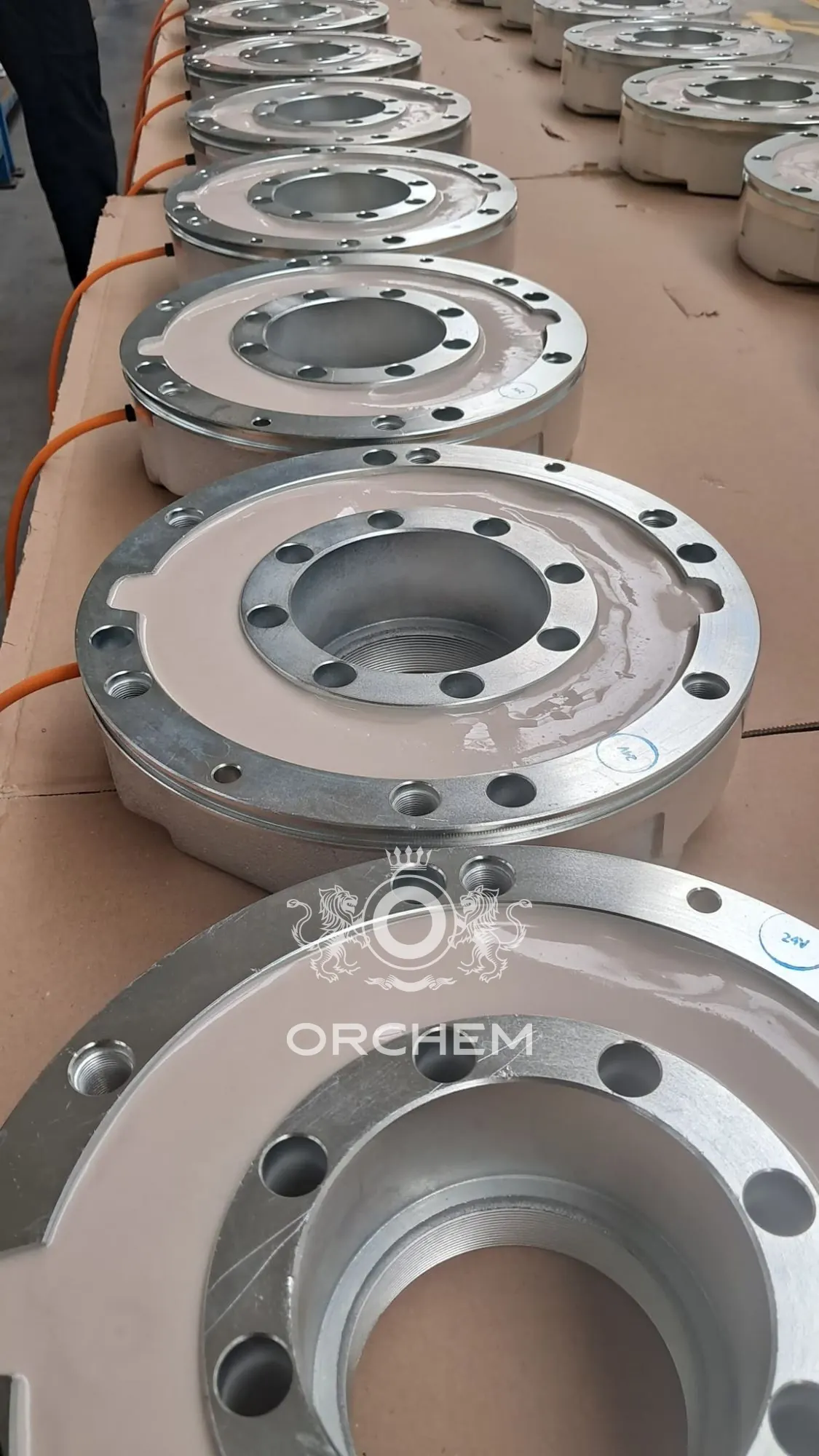
- Casting magnetic brake and clutch coils inside steel housings,
- Potting coils, sensors, transformers and inductive components,
- Encapsulating electrical and electronic modules against moisture, vibration and impact,
- Embedding and encapsulation where flame retardancy is wanted.
Why a flame-retardant filled epoxy?
The mix viscosity is low, so the resin penetrates well between windings. The flexibilised matrix keeps internal stress low as copper windings and steel housings heat up and cool down. The mineral filler gives the cured mass hardness and dimensional stability. The formulation is halogen-free and formulated in the UL 94 V-0 band; the product is not certified.
The cured material reaches 70–75 Shore D and is suitable for continuous operation up to 150 °C. Dielectric strength is 20–22 kV/mm. It shows good resistance to water, humidity, mineral and synthetic oils, and dilute acids and bases.
Application steps
- Stir part A thoroughly, including the bottom; slight filler settling is normal.
- Bring both parts to 20–25 °C. Components must be clean and oil-free; do not pour into cold steel housings.
- Weigh A:B = 5:1 by weight (for example 10 kg A + 2 kg B).
- Mix for 3–4 minutes without entraining air and scrape the sides of the container. Do not leave the mixed mass standing; it heats up exothermically.
- Pour within 20 minutes, slowly and from one point. Let it rest for 5–10 minutes. Pour deep castings in two stages.
- The part can be demoulded after 24 hours. Full cure takes 7 days at 25 °C.
Warming part A to 30–35 °C improves flow; pot life then drops to about 15 minutes. Use a silicone-free release agent for open moulds. Run thermal tests or apply full load after 48 hours at the earliest, preferably after 7 days. The minimum application temperature is 15 °C.
Storage and safety
Both parts keep for 12 months in their original closed packaging, dry, at 5–30 °C. Part B is sensitive to moisture and carbon dioxide; close it immediately after use. Slight thickening of B is normal.
Part A is irritant and a skin sensitiser; part B is corrosive. Wear nitrile gloves and safety goggles and ventilate the area. Wear an FFP3 mask when cutting or grinding cured material.
For other casting systems see casting resins and polyurethane and epoxy resins. For winding impregnation see our electrical insulating varnish and transformer varnish ranges.
Questions
Does EPC-620 need an oven?
No. EPC-620 cures at room temperature; no oven or post-cure is needed. It can be demoulded after 24 hours and reaches full cure in 7 days at 25 °C.
What is the mix ratio?
A:B = 5:1 by weight (100:20). For example, add 2 kg of part B to 10 kg of part A. Do not estimate the ratio by eye; weigh it.
Is EPC-620 UL 94 V-0 certified?
No. EPC-620 is halogen-free and formulated in the UL 94 V-0 band, but it is not certified.
How long is the pot life?
20 minutes for a 500 g mix at 25 °C. Warming part A to 30–35 °C improves flow but reduces pot life to about 15 minutes.
Can it be used for brake coils in steel housings?
Yes. Its flexibilised matrix keeps internal stress low with copper windings and steel housings under thermal cycling. Do not pour into cold steel housings; pour deep castings in two stages.
What are the shelf life and storage conditions?
Both parts keep for 12 months at 5–30 °C, dry, in the original closed packaging. Part B is moisture-sensitive; close the container immediately.