
If the wire is enamelled, why do you still need winding varnish?
Enamel vs varnish: gaps between wires, vibration, moisture, heat and class matching.
What does the enamel do?
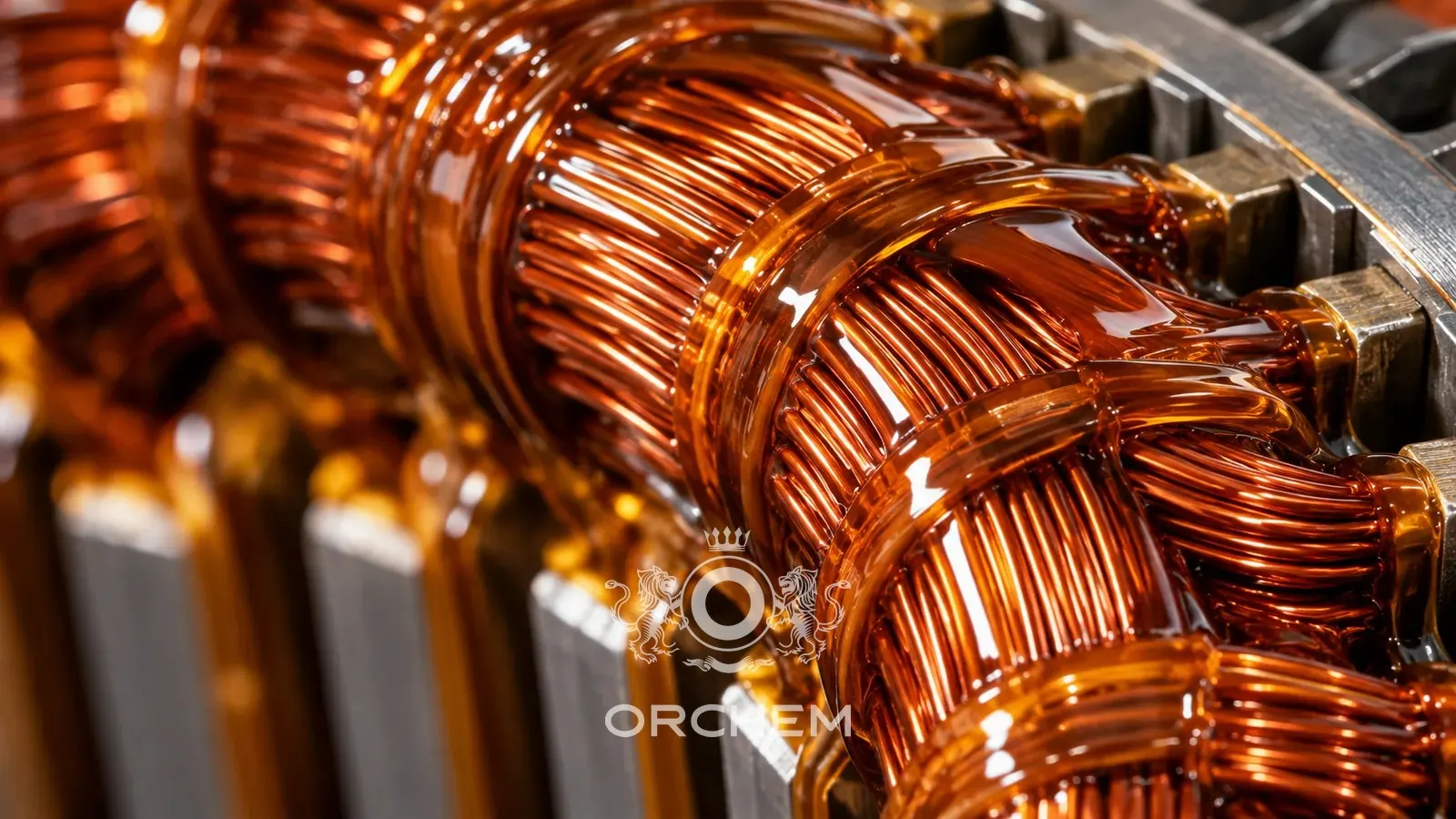
Enamel is the thin insulating coating on winding wire. It has one job: to keep each turn electrically separate from the next. The wire is coated at the factory before winding, so the enamel belongs to the wire, not to the finished winding.
Enamel is very thin and only covers the surface of each wire. Once the wires are wound and placed in the slots, air gaps remain between them. Enamel cannot fill those gaps or hold the wires together. It can also be weakened where the wire is pinched, scratched or stretched during winding.
What does winding varnish do?
Winding varnish goes on after the winding is finished. Applied by dipping, pouring or brushing, it soaks into the winding and hardens as it dries. Enamel insulates the wire; varnish protects the whole winding. One does not replace the other. They work together.
It fills the gaps between wires
A wound coil has small gaps between wires, in slot corners and in the end windings. Varnish flows into these gaps and fills them. Air pockets are electrical weak spots; once filled with varnish, the winding becomes a sounder insulation system. Tiny defects in the enamel also get covered.
It bonds the wires together
When the varnish cures, it bonds the wires to each other and to the slot. The winding stops being a loose bundle and becomes one solid block. This bond also helps the end windings keep their shape.
It protects against vibration
A running motor vibrates all the time, and every start puts extra magnetic force on the wires. Without varnish, the wires rub against each other and the enamel slowly wears away. The usual result is a turn-to-turn short and a burnt coil. Wires bonded by varnish move together and do not wear each other down.
It keeps out moisture, dust and dirt
An unvarnished winding draws in moisture and dust. Damp dirt can form a conductive path on the surface and lower insulation resistance. Varnish seals the outside of the winding and, because it fills the gaps, leaves no room for moisture to settle. The difference is clearest in motors working in damp, dusty or chemical environments.
It helps the winding shed heat
Air is a poor conductor of heat. Air gaps between wires make it harder for heat to move from the copper to the core and frame. With those gaps filled, heat flows out more easily. The winding runs cooler, and insulation life benefits.
Enamel vs varnish at a glance
| Feature | Enamel (wire coating) | Winding varnish (impregnation) |
|---|---|---|
| When is it applied? | During wire production, before winding | After winding, to the whole winding |
| What does it insulate? | Each wire on its own | The winding as a whole |
| Gaps between wires | Not filled | Filled |
| Bonds the wires? | No | Yes, into one block |
| Vibration | Can wear through by rubbing | Locks wires in place, prevents wear |
| Moisture and dirt | Limited protection | Seals and protects the winding |
| Heat transfer | No effect | Improved by filling the gaps |
Match the varnish to the wire class
Like varnish, enamelled wire is rated by thermal class. Under IEC 60085 the common classes are B (130 °C), F (155 °C) and H (180 °C). A winding is only as strong as its weakest material. Put a class B varnish on a motor wound with class F wire and the varnish becomes the weak link.
So the varnish should be rated at least as high as the wire and the motor's operating class:
- Class B work: OR-100 for small series motors.
- Class F work: OR-102 or OKA-501 for fast workshop jobs.
- Class H work: the OR-114 two-component class H varnish, OR-300 for oven-cured production, or OR-305 for transformers.
Chemical compatibility matters too. Standard enamelled wires are generally compatible with winding varnishes. If you use a wire with a special coating, check the wire maker's advice or ask us. When choosing, also weigh up air-drying versus baking motor varnishes.
Glass-fibre insulated wire production: OR-3200
On some wires the insulation is more than enamel. Glass-fibre insulated wire is wrapped with glass fibre, and that fibre layer must be saturated with varnish so it holds to the wire and acts as insulation. Orchem OR-3200 is a wire production varnish made for this job.
OR-3200 is meant for wire manufacturers. For impregnating a motor or transformer winding in the workshop, use a winding varnish. Values and application conditions are given in the product's TDS.
Helping the varnish do its job
Varnish only works once it gets inside the winding. The winding must be clean, dry and free of dust. The varnish must be at the right viscosity; varnish that is too thick sits on the surface and leaves the inner wires bare. When dipping, keep the winding in the varnish until air bubbles stop rising, then let the excess drain off. Follow the drying and curing conditions closely; half-dry varnish does not bond the wires properly. For adjusting viscosity, see our thinner ratio guide.
What happens if you skip the varnish?
An unvarnished winding may run fine at first. The trouble comes later. Vibration wears the enamel, moisture lowers insulation resistance, and the winding runs hotter. Often the result is a motor that needs rewinding far sooner than expected. The cost of varnish and impregnation is small next to a rewind.
To find the right varnish for your job, see our guide which winding varnish should you use. All the options for motor work are on our motor varnish page.


Questions
If I use enamelled wire, can I skip the varnish?
Not recommended. Enamel insulates each wire but does not fill the gaps between them or bond them. An unvarnished winding wears under vibration, absorbs moisture and runs hotter.
What is the difference between enamel and winding varnish?
Enamel is a thin insulating coating applied to the wire during production. Winding varnish is applied to the whole winding after winding; it fills the gaps and turns the winding into one block.
Does varnish make the winding run hotter?
No, usually the opposite. Air between the wires is a poor heat conductor. Once varnish fills those gaps, heat passes more easily to the core and frame.
Should the varnish class match the wire class?
It should be at least as high. A winding is only as strong as its weakest material. For a motor wound with class F wire, use a class F or H varnish.
Is every winding varnish compatible with every enamelled wire?
Standard enamelled wires are generally compatible with winding varnishes. If you use a wire with a special coating, check the wire maker's advice or ask us.
What is OR-3200 used for?
OR-3200 is a wire production varnish used to saturate the fibre layer in glass-fibre insulated wire. For impregnating windings in the workshop, use a winding varnish.
Updated: