
Electrical insulation glossary
Short, plain definitions of the terms used in varnishing windings, motors and transformers.
A
- Air-drying varnish
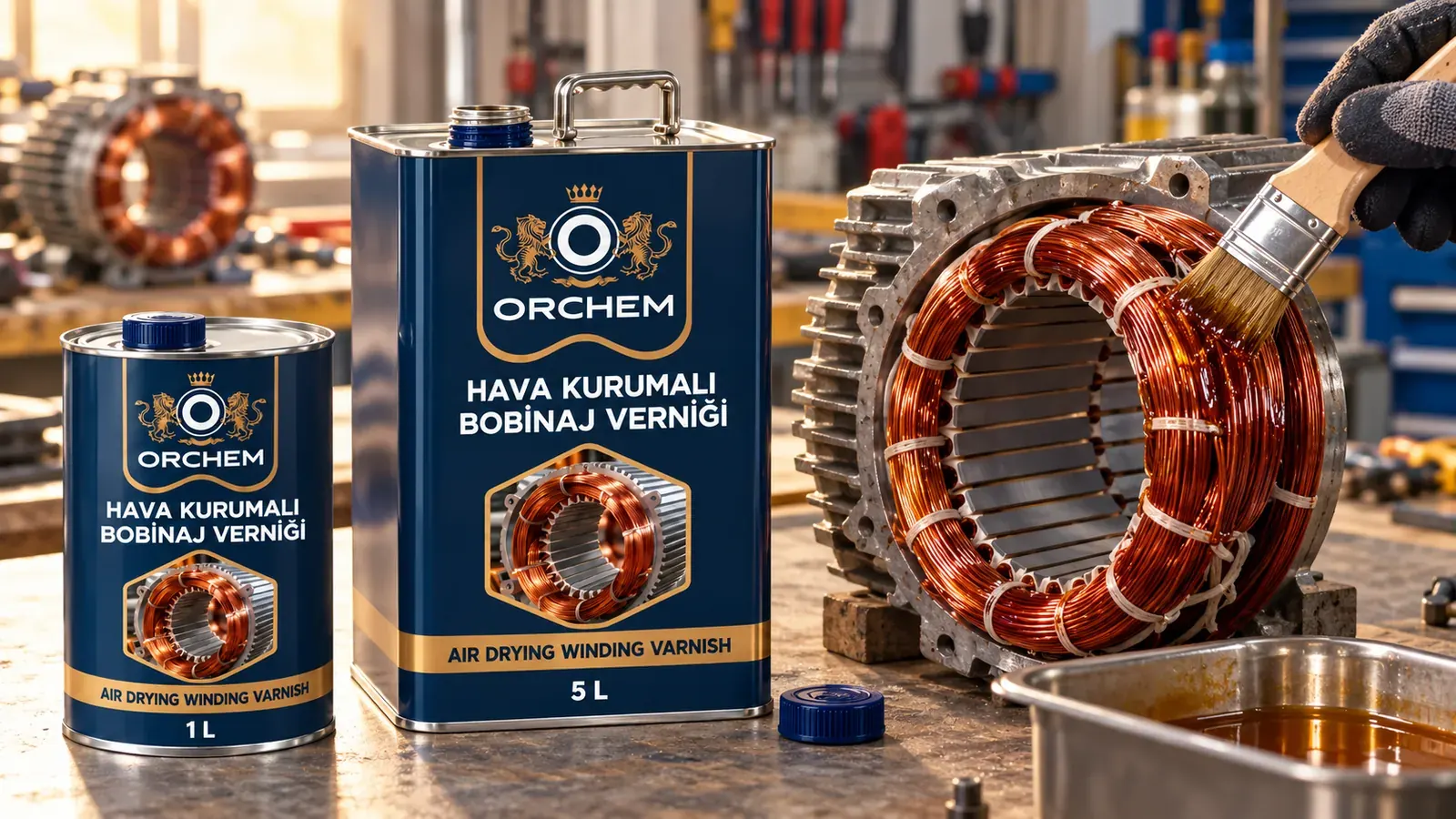
- A varnish that dries at room conditions without an oven, which makes it practical for rewind shops and on-site repairs. Orchem OR-100, OR-102 and OKA-501 belong to this group; see air-drying motor winding varnishes.
- Anti-flash
- A general term for coatings meant to reduce surface arcing and flashover. The aim is a smooth insulating film, especially around the commutator and end windings, that makes it harder for dust and moisture to form a conductive path. Orchem's anti-flash insulating topcoats are OR-411 and OR-990.
- Armature
- The rotating part of DC and universal (commutator) motors that carries the winding and the commutator. Because armatures run at high speed, the varnish must bond the winding firmly.
B
- Baking (oven-curing) varnish
- A varnish that cures with heat in an oven. It usually gives a tougher, thicker film and suits series production. Orchem's options are on the oven-curing motor winding varnishes page; oven temperature and time are in the product's TDS.
- Breakdown voltage
- The voltage at which an insulating material fails electrically and starts to conduct. The more even and void-free the varnish film, the higher the breakdown voltage.
- Brush application
- Applying varnish to the winding with a brush, used for small repairs, touch-ups and one-off jobs. Air-drying varnishes are well suited to brushing.
C
- Class B
- The thermal class with a maximum continuous operating temperature of 130 °C under IEC 60085. Orchem OR-100, a phenolic air-drying varnish, is Class B.
- Class F
- The thermal class with a maximum continuous operating temperature of 155 °C under IEC 60085. Orchem OR-102, OKA-501 and OR-105 are Class F varnishes.
- Class H
- The thermal class with a maximum continuous operating temperature of 180 °C under IEC 60085. At Orchem, OR-114 Class H varnish, the OR-300 baking motor varnish, the OR-305 transformer varnish and the OR-411 topcoat are in this class.
- Commutator
- The ring of copper segments on the armature that passes current to the winding through the brushes. The commutator surface itself is not varnished, but the winding leads soldered to its segments should be well coated.
- Core
- The stack of thin silicon-steel laminations that carries the magnetic flux in transformers and motors. Windings sit on the core or in its slots.
- Curing
- The stage where a varnish does not just dry but hardens chemically and reaches its final properties. In baking varnishes heat drives it; in two-component varnishes it comes from the reaction with the hardener.
D
- Dielectric strength
- The electric field strength an insulating material can withstand without breaking down, usually given as voltage per unit thickness (kV/mm). For each varnish this value is in its TDS.
- Dipping
- Impregnating a winding or stator by lowering it into a varnish tank. Once the varnish has soaked in, the part is lifted out, drained and dried.
- Dry-type transformer
- A transformer cooled by air instead of oil, with windings protected by varnish or resin. With no oil around it, the insulation system alone has to protect against moisture and dust.
E
- Enamelled wire
- Copper or aluminium winding wire coated with a thin film of enamel (wire lacquer). The enamel insulates each wire; the impregnating varnish fills the gaps between wires and strengthens the winding mechanically and electrically.
- End winding
- The part of the winding that sticks out of the slots at both ends of the stator. It is the area most exposed to vibration and dirt, so the varnish must bond and cover it well.
F
- Film thickness
- The thickness of the varnish or paint layer left on the surface after drying. Too thin a film gives poor protection; too thick a film may not dry through or may crack.
G
- Glass-fibre insulated wire
- Conductor wire wrapped in glass fibre and bonded with varnish, used in large motors and transformers that run hot. Orchem OR-3200 is a varnish made for producing glass-fibre insulated wire.
H
- Hardener
- The component that is mixed with the base in a two-component varnish to start curing. The mixing ratio is given in the product's TDS and must be followed exactly, or the varnish may not harden.
I
- IEC 60085
- The international standard that classifies electrical insulation systems by the temperature they can withstand. It defines thermal classes by letter or temperature, for example B 130 °C, F 155 °C and H 180 °C.
- Impregnation
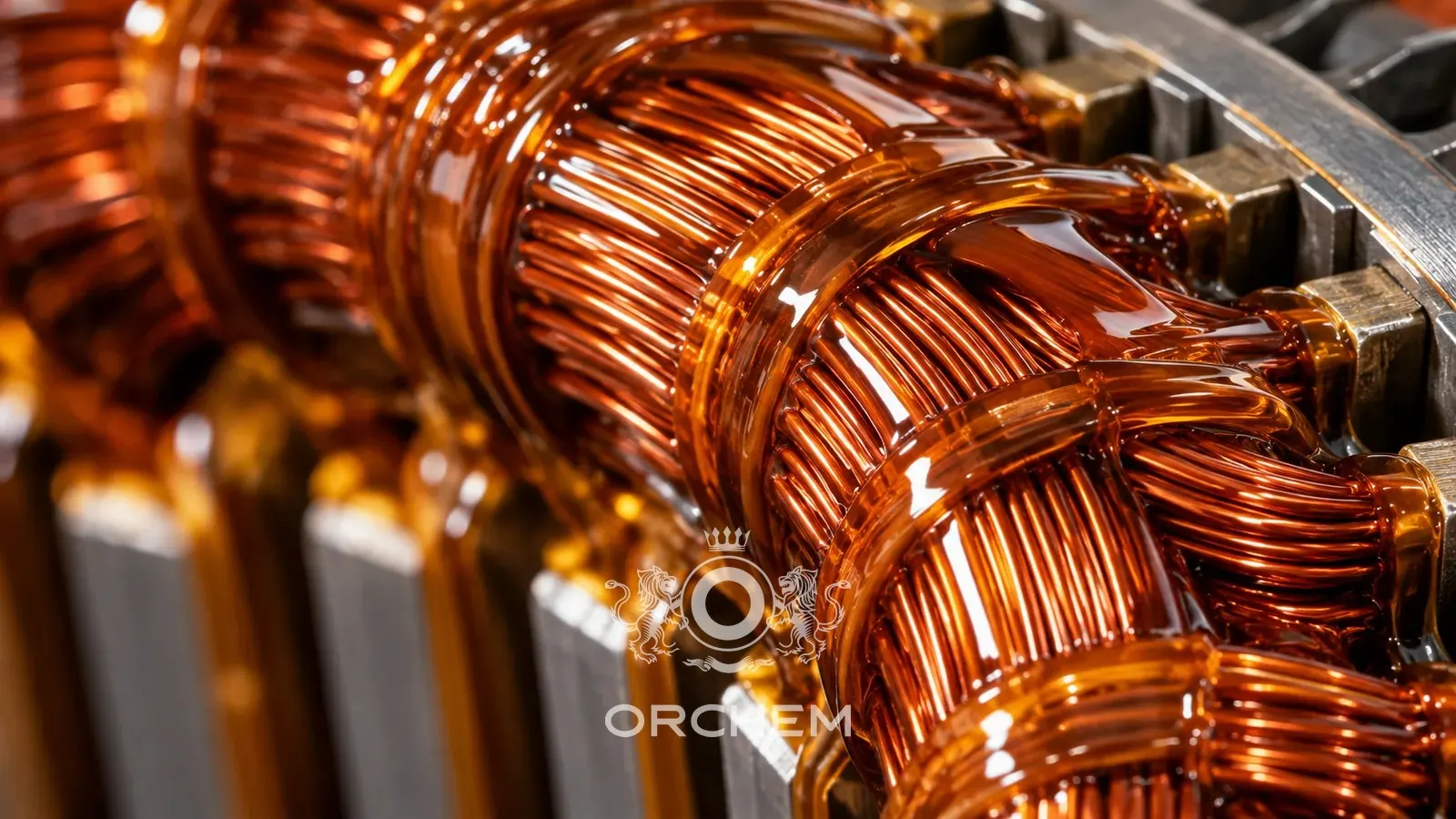
- Saturating a winding with varnish: the varnish fills the gaps between the wires and, once cured, locks the winding into one solid body. It protects against moisture, vibration and dust, and helps carry heat out of the winding.
- Insulating varnish
- The general name for varnishes used to insulate conductors from each other and from the frame. Winding, transformer, topcoat and circuit-board varnishes all belong to this family; see electrical insulating varnish.
- Insulation resistance
- The electrical resistance between the winding and the frame (or between windings), measured in megohms (MΩ). A falling value usually points to moisture, dirt or insulation damage.
L
- LV / MV transformer
- Low-voltage (LV) and medium-voltage (MV) transformers. Higher voltage puts more electrical stress on the winding insulation, so varnish choice and impregnation quality matter even more in MV units.
M
- Megger
- An instrument that measures insulation resistance by applying a DC test voltage to the winding; the name comes from a brand that became a common word. Low-voltage motors are usually tested at 500 V or 1000 V.
- Moisture
- Moisture in a winding is the most common cause of low insulation resistance. The winding should be dried before impregnation, and the varnish should keep moisture out afterwards.
- Motor varnish
- Varnish used to impregnate electric motor windings. It is chosen as air-drying, baking or two-component according to the motor's thermal class, speed and operating environment.
R
- Rotor
- The rotating part of a motor. Induction motors usually have an unwound (squirrel-cage) rotor; wound rotors are impregnated just like stators.
S
- SDS / MSDS
- The Safety Data Sheet, giving a chemical's hazards, safe handling, storage and first-aid information. MSDS is the older name; in Turkish it is called GBF.
- Slot
- The channels in the stator or rotor lamination stack that hold the winding. Slots are lined with insulating paper, and the varnish fills the space between the wires inside them.
- Solids content
- The percentage of resin left in a varnish after the solvent has evaporated. A high-solids varnish leaves more film per coat; Orchem OR-105 is a high-solids transformer varnish.
- Solvent
- The liquid that dissolves the resin in a varnish and evaporates after application. Solvent vapours are flammable, so the work area should be well ventilated.
- Spray-gun application
- Applying varnish or topcoat with a spray gun, which is fast for large surfaces and finishing coats. The consistency is adjusted to the gun with thinner.
- Stator
- The stationary outer part of a motor whose slots hold the winding. In rewind shops, the stator is usually the part that gets varnished.
T
- TDS (Technical Data Sheet)
- The document that gives a product's properties, application methods, thinning ratio and drying conditions. For exact values such as drying time, oven temperature and viscosity, check the product's TDS.
- Thermal class
- The highest temperature an insulating material or system can withstand continuously without shortening its life. The varnish should be in the same or a higher thermal class than the wire and other insulation in the winding.
- Thinner
- The solvent added to bring a varnish to application consistency. Always use the matching thinner: T-100 for Orchem air-drying varnishes, T-501 for OKA-501 and T-300 for baking varnishes; see thinner types.
- Topcoat insulating lacquer
- A protective insulating coating applied to the outside of the winding after impregnation, shielding it from moisture, dust and chemicals. Orchem offers OR-411 (epoxy-based, Class H) and OR-990 (thermal class range 155–180 °C); see topcoat insulating lacquers and paints.
- Tracking
- Dirt and moisture on an insulating surface gradually forming a conductive track that current leaks along. A smooth, closed varnish or topcoat film lowers the risk of tracking.
- Transformer varnish
- Varnish used to impregnate transformer windings; it keeps moisture out and holds the winding together against short-circuit forces. For air-drying and baking options, see transformer varnish.
- Trickle impregnation
- A method where varnish is poured in a thin stream onto a rotating or tilted winding. It uses less varnish than dipping and suits series production and large stators.
- Two-component varnish
- A varnish whose base and hardener are mixed in a set ratio just before use and harden by chemical reaction. Orchem OR-114 is a two-component polyurethane Class H varnish that dries at room temperature.
V
- Variac
- An autotransformer with adjustable output voltage, where a carbon brush runs over the winding. It must be varnished so that the track the brush touches stays bare.
- Viscosity
- How thick or runny a varnish is. If viscosity is too high the varnish will not penetrate the winding well; it is adjusted with thinner, and the product value is in the TDS.
- VOC
- Volatile organic compounds: the solvent vapours released into the air as a varnish dries. Low-VOC products are better for the workplace; Orchem OR-307 is a low-VOC baking varnish.
- VPI (vacuum pressure impregnation)
- An impregnation method where air is first drawn out of the winding under vacuum, the winding is flooded with varnish, and pressure then pushes the varnish into the smallest gaps. It is used for high-voltage and large machines; Orchem OR-300 and OR-305 are suitable for VPI.
W
- Water-based varnish
- A varnish that uses mostly water as its solvent and releases less organic solvent vapour. Orchem OR-306 is a water-based baking varnish.
- Winding varnish
- Insulating varnish used to impregnate motor, transformer and coil windings. It fills the gaps between the wires, bonds the winding into one body and protects it from moisture. See winding varnish for the range.


Questions
What is impregnation?
Impregnation means saturating a winding with varnish. The varnish fills the gaps between the wires and, once cured, locks the winding into one solid body, protecting it from moisture, vibration and dust and helping heat escape. It can be done by dipping, trickle, brush or VPI.
What is VPI?
VPI stands for vacuum pressure impregnation. Air is first drawn out of the winding under vacuum, the winding is flooded with varnish, and pressure then pushes the varnish into the smallest gaps. It is preferred for high-voltage and large machines; Orchem OR-305 transformer varnish can be applied by VPI.
What is a thermal class?
A thermal class is the highest temperature an insulating material can withstand continuously without shortening its life. Under IEC 60085, Class B is 130 °C, Class F is 155 °C and Class H is 180 °C. The varnish should match or exceed the class of the wire in the winding.
Is curing the same as drying?
Not quite. Drying is the solvent evaporating until the surface can be touched; curing is the varnish hardening chemically and reaching its final properties. Baking varnishes cure with heat, two-component varnishes cure through the reaction with the hardener.
What is insulating varnish?
Insulating varnish is the general name for varnishes that insulate conductors from each other and from the frame. Winding and motor varnishes, transformer varnishes, topcoat insulating lacquers and circuit-board varnishes all belong to this family.
Updated: